What Is Wearable Health Tech?
Wearable health technology refers to devices you wear (on wrist, finger, clip-on, hearables, etc.) that monitor metrics like heart rate, sleep, activity, and more advanced biometrics like blood oxygen, HRV, body temperature, etc. These devices aim to give daily feedback, help with lifestyle adjustments, and sometimes serve as early warning for potential health issues.
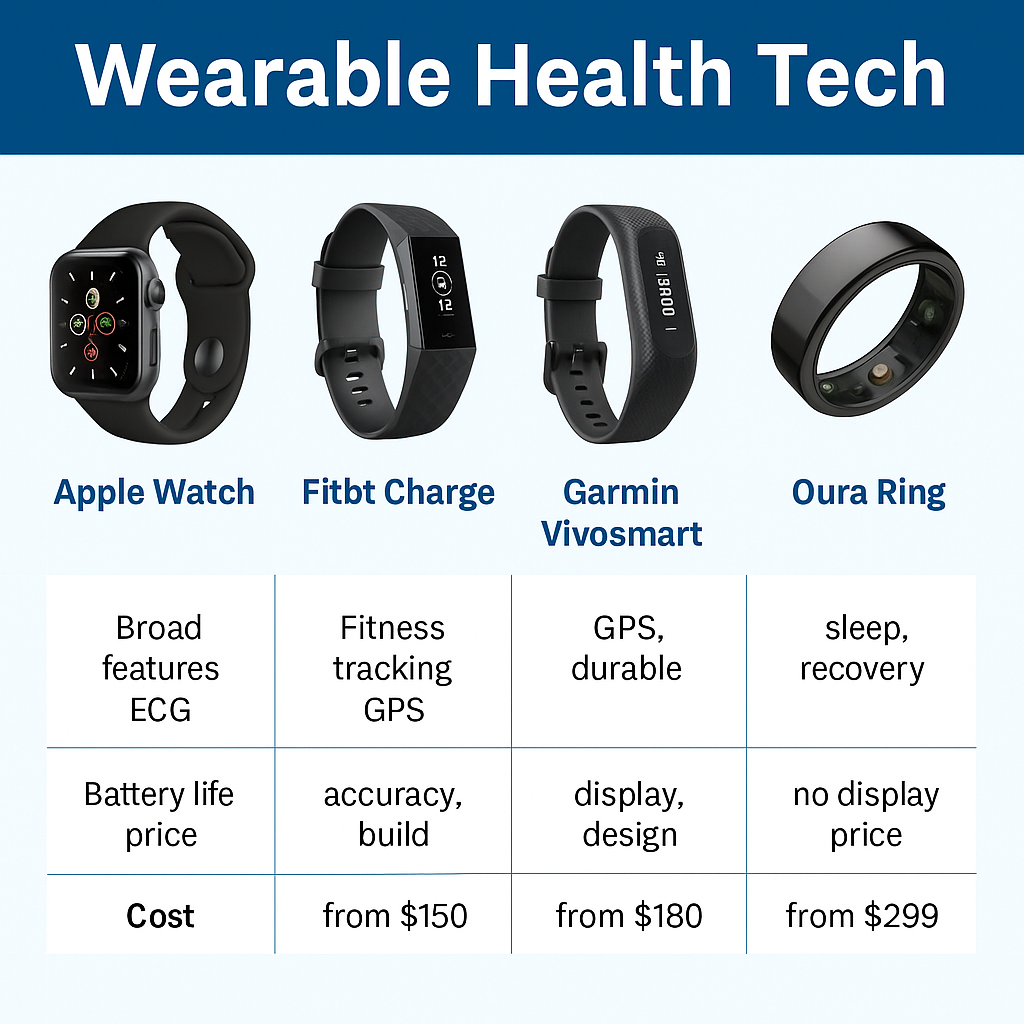
Popular Wearable Devices: Pros, Cons, & Costs
Here are some of the more well-known wearable devices, what they do well, and where they fall short:
| Device / Brand | What It Does Well | Weaknesses / Limitations | Approx Cost |
|---|---|---|---|
| Apple Watch | Excellent heart rate tracking, ECG capability, fall detection, integration with iPhone. Broad sensor suite. | Battery life is limited (usually 1-2 days under heavy use). Expensive. Some measures like energy/calo burn may be off. aim7.com+2Business Insider+2 | Varies: newer models often $399-$799 or more |
| Oura Ring | Very good for sleep tracking, resting heart rate, some HRV, more discreet form (ring vs wrist). aim7.com+2Wikipedia+2 | Not as good for active workouts; some features behind subscription; small device may need to be tight. Expensive for what amount of active tracking. The Verge+1 | $299-$349+ plus subscription fees |
| WHOOP Strap | Excellent for tracking recovery, strain, sleep; used by athletes; focuses on readiness scoring and how well you recover. Wikipedia+2PMC+2 | No screen, you must use phone/app. Subscription cost required. Less ideal for someone wanting standalone hardware. | Device cost + recurring membership (varies) |
| Fitbit / Garmin / Samsung | Strong activity tracking, lots of accessory features, GPS, nice ecosystem & companion apps; good for more general health/fitness users. | Accuracy can vary especially with calorie estimates, sleep stage detection, HRV. Metrics can be inconsistent. aim7.com+1 | Lower-end models can be $100-$200; premium ones $250-$400+ |
New Biometrics Being Introduced & What’s Emerging
Wearable tech is expanding beyond just steps, sleep, and heart rate. Some of the newer or emerging biometric measurements include:
- Continuous Blood Pressure Estimation – Sensors (optical / PPG + AI) are being developed so that a wearable can estimate blood pressure without a cuff. Early versions show promise but still have limitations in accuracy. Ambiq+1
- Respiratory Rate / Breathing Metrics – More devices are monitoring breathing rate, even subtle changes, especially during sleep. PMC+1
- Skin Temperature & Peripheral Temperature Variations – Useful for tracking illness onset, menstrual cycle, circadian rhythm. Oura ring & other devices are pushing this. Wikipedia+1
- Blood Oxygen Saturation (SpO₂) – Many devices do this now. However, accuracy depends on sensor placement, lighting, motion. aim7.com+2Wikipedia+2
- Heart Rate Variability (HRV) – Already common in fitness & recovery wearables. Newer sensors are more sensitive and more frequently sampling. Good for stress, recovery tracking. aim7.com+2PMC+2
- Glucose & Metabolic Tracking – Still more limited and often requires external patches or invasive sensors. Some pairing of wearables with CGMs etc. Wikipedia+1
Accuracy: What Can You Trust, What to Use with Caution
While many wearables do a good job for general health tracking, there are some caveats:
- Studies show heart rate (resting) and sleep duration are often relatively accurate in many devices. However, active (high intensity) heart rate tracking and calorie burn estimations are less reliable. Errors in calorie estimates can be large. aim7.com+1
- Sleep stages (light / deep / REM) often vary significantly between devices. They should be viewed as rough guides, not medical diagnostics.
- Sensor placement matters. A sensor on the wrist may be less reliable than one on finger or chest for some metrics.
- Environmental factors (motion, temperature, lighting) degrade accuracy.
- Newer sensors and algorithms are improving, and some are getting very close to medical-grade or cleared devices, but they are not a substitute for clinical diagnostics when needed. PMC+2Frontiers+2
Pros & Cons of Using Wearable Health Tech
Pros:
- Increased awareness of patterns (sleep, stress, recovery)
- Motivation to move more and establish healthier habits
- Early detection of changes in health (resting heart rate up, recovery low, etc.)
- Data for doctors/chiropractors to better understand patient’s daily health trends
Cons:
- Cost can be high, especially premium devices + subscription fees
- Information overload or anxiety — some users get stressed watching metrics
- Privacy concerns – where is the data stored, who can access it
- Not always accurate; relying solely on the device for medical decisions can be risky
Should You Get One? What to Look For
If you’re considering a wearable device, here are some tips to choose wisely:
- Decide what you want to monitor ‒ e.g. sleep, stress, recovery, HRV, activity, glucose, etc. Don’t get features you won’t use.
- Battery life & comfort matter — you’ll use whats comfortable and easy.
- Sensor quality & sample rate — higher sample rate often gives better accuracy, especially for metrics like HRV or respiration.
- Ecosystem / app / data export — can you see trends over time, export data, or integrate with your health provider or clinic?
- Cost vs recurring fees — upfront cost + monthly subscriptions can add up.
Final Thoughts: The Future of Wearable Health Tech
Wearables are no longer just “fitness toys.” They’re evolving toward medical grade, with more advanced biometrics, better sensors, more validation in clinical studies. But it’s still early. For most people, the best return comes from choosing a device that supports their goals (better sleep, stress management, activity) and using it as part of an overall wellness plan (nutrition, chiropractic, lifestyle).
At Aiello Family Health, we encourage patients who use wearables to bring their data to sessions — it can help us understand their stress, sleep, recovery patterns, and personalize care accordingly. But we also remind folks: these devices support health — they don’t replace professional evaluation. We also like to test the emf and radiofrequency against the nervous system to make sure these devices are not putting the patient out of neurologic balance.