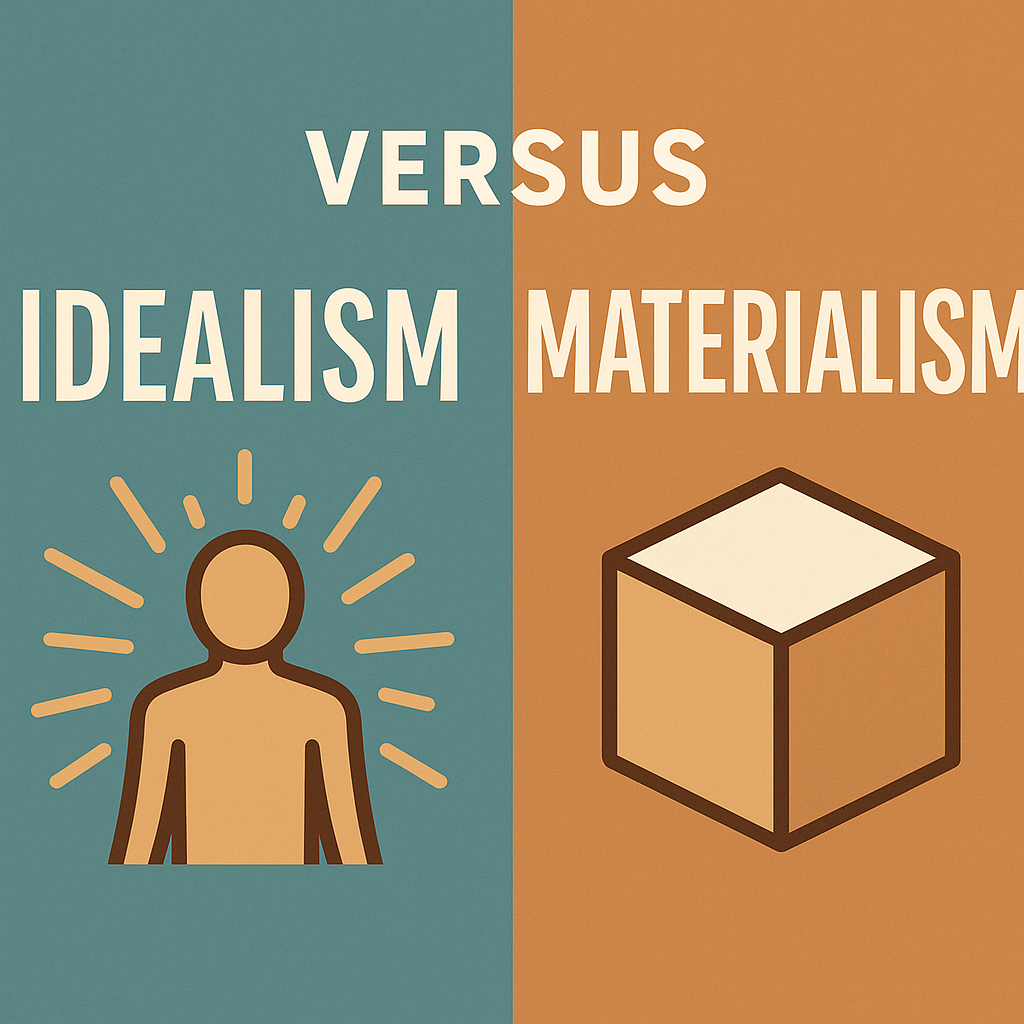
When we ask ourselves the biggest questions—What is real? What is the nature of existence? Where does consciousness come from?—we inevitably find ourselves in the middle of one of philosophy’s oldest and most enduring debates: idealism vs. materialism. These two worldviews stand in contrast, offering fundamentally different ways of interpreting reality. Idealism insists that mind or spirit is primary, that the world we experience is in some sense mental. Materialism, on the other hand, grounds everything in matter, claiming that what truly exists are physical processes and energy, with consciousness itself emerging from them.
Although these may sound like abstract metaphysical stances, the clash between idealism and materialism has shaped science, politics, religion, art, and culture for centuries. It’s not just a question for armchair philosophers—it’s a debate that continues to influence neuroscience labs, political movements, quantum physics, and even the way we live our everyday lives.
Ancient Beginnings: The First Philosophical Divide
The roots of this divide stretch back to ancient Greece. Plato (427–347 BCE) is often remembered as the father of idealism. In his Theory of Forms, he argued that the material world we see around us is only a shadow or copy of a higher, immaterial reality—the realm of pure Forms or Ideas. To Plato, the form of “justice,” “beauty,” or “triangle” is more real than any specific instance of it. Matter is transient and imperfect, but mind and Idea are eternal.
In contrast, Democritus (460–370 BCE) and later Epicurus (341–270 BCE) built the foundation for materialism with their atomist theories. They believed that everything in the universe, including the soul, could be explained in terms of atoms moving in the void. The beauty of a flower, the warmth of the sun, even human thought—these, they claimed, arise from the physical interactions of tiny, indivisible particles.
Thus, from philosophy’s earliest days, two visions of reality emerged: one that saw mind or spirit as the essence of being, and another that insisted only matter is truly real.
Idealism Through the Ages
The idealist tradition continued strongly through the Middle Ages and into modern philosophy. Early Christian thinkers like St. Augustine (354–430) wove Plato’s ideas into theology, teaching that the material world is less real than the eternal truths of God.
Later, in the 18th century, George Berkeley (1685–1753) pushed idealism to its most radical form. His famous phrase, esse est percipi—to be is to be perceived—captured his belief that objects don’t exist independently of our perception of them. For Berkeley, the tree in the forest makes no sound if no one hears it, unless you believe, as he did, that God is the eternal perceiver ensuring continuity.
Immanuel Kant (1724–1804), though not a pure idealist, revolutionized philosophy with his Critique of Pure Reason. He argued that we never know “things-in-themselves” (noumena); we only know the phenomena shaped by our mind’s structures of perception. Space, time, and causality, Kant suggested, are not features of the external world but categories of human cognition. In this way, Kant’s “transcendental idealism” made the mind central to the very possibility of experience.
The 19th century brought G.W.F. Hegel (1770–1831), who saw reality as the unfolding of an absolute Spirit through history. For Hegel, the material world and human history were expressions of a greater rational order working itself out through dialectical progress.
The Rise of Materialism
Materialism also had its champions, and it gathered strength with the rise of modern science. Thomas Hobbes (1588–1679) famously described even human thought as “but a motion in some part of the organ of sense.” For Hobbes, everything mental was reducible to mechanics of matter.
In the 18th century, figures like Julien Offray de La Mettrie wrote works such as Man a Machine (1747), where he argued that the human body—and mind—operates as a complex mechanical system. These ideas dovetailed with the Enlightenment’s emphasis on science and empiricism.
The 19th century saw the emergence of Karl Marx (1818–1883) and Friedrich Engels (1820–1895), who developed dialectical materialism. They rejected Hegel’s idealist dialectics, grounding historical development instead in material conditions—economics, labor, and class relations. According to Marx, “It is not the consciousness of men that determines their being, but their social being that determines their consciousness” (A Contribution to the Critique of Political Economy, 1859). In other words, material circumstances shape ideas, not the other way around.
As the natural sciences advanced—Darwin’s theory of evolution, discoveries in chemistry and physics, and later neuroscience—the materialist perspective grew dominant. The success of science in explaining phenomena without recourse to metaphysics or spirit gave materialism a powerful edge.
What Each View Implies
Idealism insists that consciousness is fundamental. If this is true, then science must account for the role of the observer, and reality itself might depend on mind. In practical terms, this has influenced religion, ethics, and even interpretations of quantum mechanics, where some physicists note that observation seems to play a role in shaping outcomes.
Materialism, on the other hand, holds that everything can ultimately be explained in physical terms. This worldview drives scientific realism, medicine, and technology. If the brain creates consciousness, then studying neurons will eventually unlock the mysteries of thought. This perspective also underlies secular humanism and political systems like socialism, where material conditions of life are emphasized over spiritual ideas.
Quantum Physics, Consciousness, and Two Ways of Explaining Illness
No scientific field unsettled the materialist picture more than quantum physics. At everyday scales, matter behaves predictably: billiard balls collide; planets orbit; drugs bind to receptors. But in the quantum world, particles behave like waves of possibility until measurement “selects” a concrete outcome. That odd dependence on observation has tempted many to ask whether the mind plays a constitutive role in physical reality.
Early pioneers wrestled openly with this. Niels Bohr argued we must describe experiments in classical terms, but the quantum state itself represents knowledge—what can be said about nature, not necessarily what is there. John von Neumann formalized measurement as a chain that, in principle, could continue until it meets a conscious observer. Eugene Wigner wondered if consciousness collapses the wave function. Others, like Hugh Everett, avoided mind by proposing the many-worlds interpretation: all outcomes occur, branching universes remove the need for collapse. More recent takes—QBism, relational quantum mechanics, decoherence-plus-emergence—keep consciousness out of the equations yet still concede that information, perspective, and context matter in how we talk about physical events.
Two takeaways are relevant for health:
- Context and interaction change outcomes. Quantum systems are not isolated; how we probe them matters. In medicine, a parallel (not an identity) appears in the way setting, expectations, and relationships influence physiology—think placebo/nocebo, therapeutic alliance, and stress biology. This doesn’t make illness “all in your head”; it reminds us that living systems are exquisitely sensitive to informational and relational inputs.
- Information is physical. Modern physics and biology converge on the idea that information is not an afterthought. DNA is coded information; neuronal patterns carry meaning; immune memory is informational. Even strictly materialist scientists now talk about signals, networks, and control theory alongside molecules. That opens conceptual space for approaches that treat disrupted signaling and regulation—not just broken parts—as core to disease.
Bioenergetics vs. Allopathic Material Causation
With those lessons in mind, consider two contrasting pictures of illness:
- Allopathic (material-cause) model: Disease is driven by discrete physical causes—pathogens, toxins, genetic mutations, structural damage, receptor-level errors. The toolkit is correspondingly physical: pharmaceuticals (molecular ligands), surgery, radiation, and targeted devices. This model excels at acute care (appendicitis, pneumonia, trauma) and many chronic conditions with clear mechanistic levers.
- Bioenergetic/regulatory model: Disease reflects dysregulation in the organism’s networks—autonomic nervous system, neuro-endocrine-immune loops, fascial/connective-tissue signaling, mitochondrial redox balance, circadian timing, and subtle electromagnetic or mechanical cues. Here, health is the capacity to maintain coherent order across scales; illness is a loss of coherence (noise, stagnation, maladaptive set-points). Interventions aim to restore pattern and flow: sleep/circadian repair, breath and vagal-tone work, light/temperature cues, movement and fascia work, nutrition timing, stress and meaning frameworks. In short, bring balance to the bioelectromagnetic system.
These paradigms are not enemies so much as different lenses on the same organism. Material causes are real; so are system-level regulations that determine how a given cause plays out in a given person.
Where Consciousness Touches Biology
A bioenergetic view treats consciousness—not as a ghost—but as a regulator injected into physiology through identifiable pathways:
- Psychoneuroimmunology: Perception of safety/danger shifts the hypothalamic–pituitary–adrenal axis, sympathetic tone, cytokines, and antibody responses. Classic work by Ader & Cohen showed immune conditioning; modern work maps how stress appraisals alter inflammatory gene expression.
- Autonomic coherence: Breathing patterns, attention, and emotion can entrain heart-rate variability (HRV) and vagal tone, which in turn influence gut motility, immune regulation, and pain perception.
- Placebo/nocebo as signal biology: Expectation changes endogenous opioids, dopamine, and cholecystokinin pathways; belief becomes a biological input, not mere “suggestion.”
Although quantum mechanics does not prove that mind controls molecules, it legitimizes the general idea that observation, information, and relationship matter in physical outcomes. In complex adaptive systems like humans, those informational inputs travel through well-mapped neural, endocrine, and immune circuits.
Integrating the Lenses in Clinical Practice
In a clinic such as Aiello Family Chiropractic, that treats a wide variety of illnesses such as, vertigo, migraines, menopausal symptoms, plantar fasciitis, or “brain fog,” the integration looks like this:
- Rule in/out material causes (the allopathic duty): imaging or referral when warranted; red-flag screening; evidence-based co-management and medication when indicated.
- Address regulatory terrain (the bioenergetic duty): circadian health, light exposure, sleep timing; breath and HRV training; graded movement and fascial glide; nutrition rhythm and glucose stability; social connection and stress reframing; targeted modalities such as acupuncture, massage therapy, chiropractic, homeopathy, and low-level laser to restore signal quality in dysregulated loops.
- Leverage consciousness as physiology: clear explanations, expectation setting, and a caring alliance—because meaning changes biology.
A Synthesis, Not a Standoff
Materialism, at its best, gives us crisp causal levers; idealist-leaning or bioenergetic perspectives remind us that order, information, and awareness shape how those levers behave in living systems. Quantum theory doesn’t hand medicine a mystic shortcut, but it does caution humility: at fundamental levels, relation and measurement matter. In whole-person care, relation and meaning matter too—and we can trace their effects through nerves, hormones, immune messengers, fascia, and mitochondria.
For patients, the pragmatic message is simple: treat the cause when you can, and always treat the system that encounters the cause. In practice, that means using the best of allopathic tools while restoring coherence with bioenergetic strategies—an approach where acupuncture is a natural fit.
Why This Debate of Idealism vs. Materialism Still Matters
Though centuries old, this debate is far from academic trivia. In neuroscience and AI research, the question remains: can consciousness be explained entirely by material processes, or is there something irreducible about mind? In politics, materialist approaches like Marxism still influence discussions about economics and inequality, while idealist perspectives inspire utopian visions and spiritual movements.
Even in our daily lives, these worldviews shape our perspectives. A materialist might say your sense of self is the product of neurons firing in your brain. An idealist might argue that your consciousness cannot be reduced to molecules, that your subjective experience points to something beyond matter. Which you lean toward influences how you see life, death, morality, and meaning.
Conclusion
Idealism vs. materialism represent two poles of human thought: one beginning with mind, the other with matter. Both have rich traditions, both have produced powerful insights, and both face profound challenges. Perhaps the ultimate truth lies not in choosing one over the other but in recognizing that our search for understanding is enriched by the tension between them.
As philosopher William James once put it, philosophy is less about reaching final answers than about “enlarging the picture of the world.” The dialogue between idealism and materialism continues to do just that—reminding us that reality, whether grounded in mind or matter, is far richer than we may ever fully grasp.